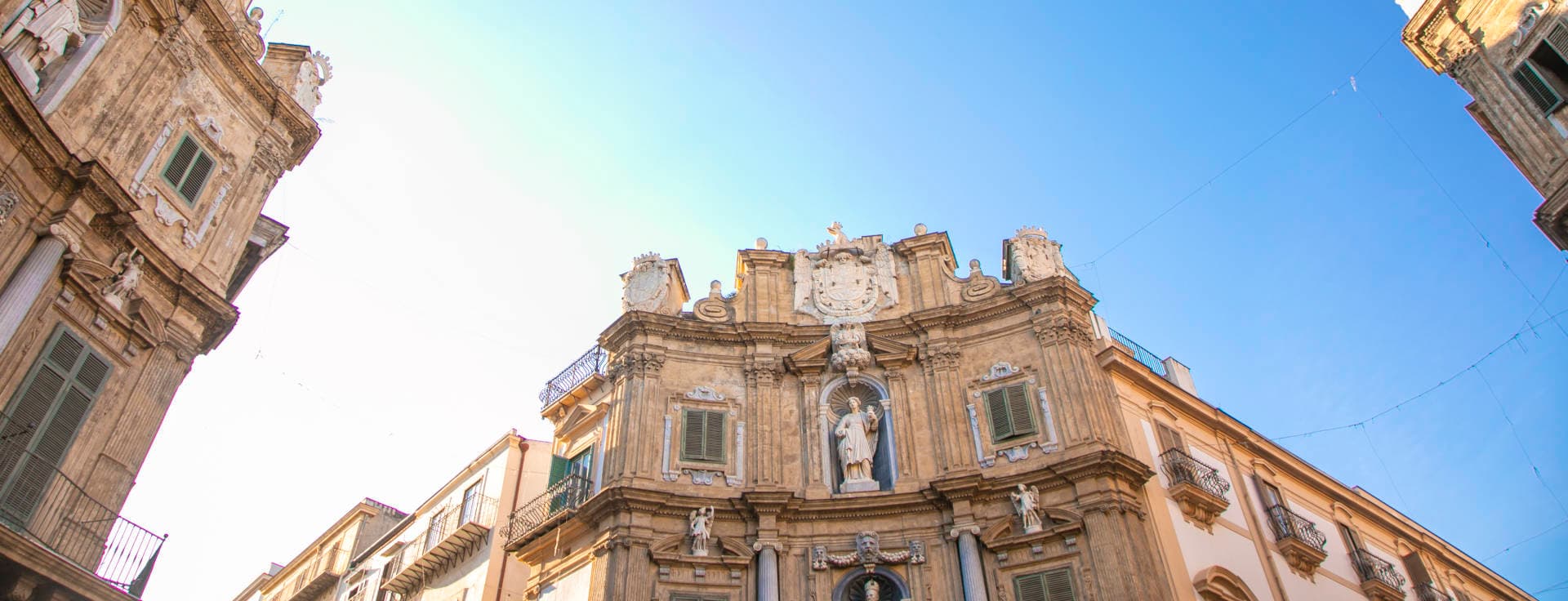
Palermo's historic centre is undoubtedly one of the largest in Europe and the world. Rich in history, culture and tradition, it stretches from the sea towards the mountain — from Porta Felice to Porta Nuova — along the Cassaro; from Teatro Massimo it then runs along Via Maqueda to the Central Station. It is at the Quattro Canti that the two axes meet, creating one of the most striking open-air monuments of Sicilian Baroque. It was the opening of Via Maqueda — willed by the Spanish viceroys between the 16th and 17th centuries — that redrew the city, dividing it into four quarters (mandamenti), each with its own patron saint.
The four quarters
Albergheria or Palazzo Reale, on the site of the Paleopolis and the city's administrative centre, home to the Norman Palace, with patron Saint Christina.
Seralcadio or Monte di Pietà, which included the Cathedral and the Capo Market, with patron Saint Nympha.
La Loggia or Castellammare, starting from the port — today La Cala — and including the fortress of the Castello a Mare, with patron Saint Olive.
Kalsa or Tribunali, seat of the Arab fortress and the courts of the Inquisition, such as Palazzo Chiaramonte, with patron Saint Agatha.
A walking itinerary from the B&B
Palermo deserves to be seen carefully, yet it offers immediate charm even to those who spend just a few days. B&B Gallery Luxury, in the historic centre along Via Maqueda, is the ideal base: bright and welcoming, strategically placed for those who want to live the city by day and during its nightlife, and to taste all its flavours, from the gourmet restaurant to street food.
From the B&B you can follow a walking route that takes in the Arab-Norman monuments and the historic markets, deciding freely how long to linger at each stop: letting yourself be captivated by the colours and sounds of the market, or pausing in one of the city's parks with something typical to eat, is the true luxury of a holiday here.
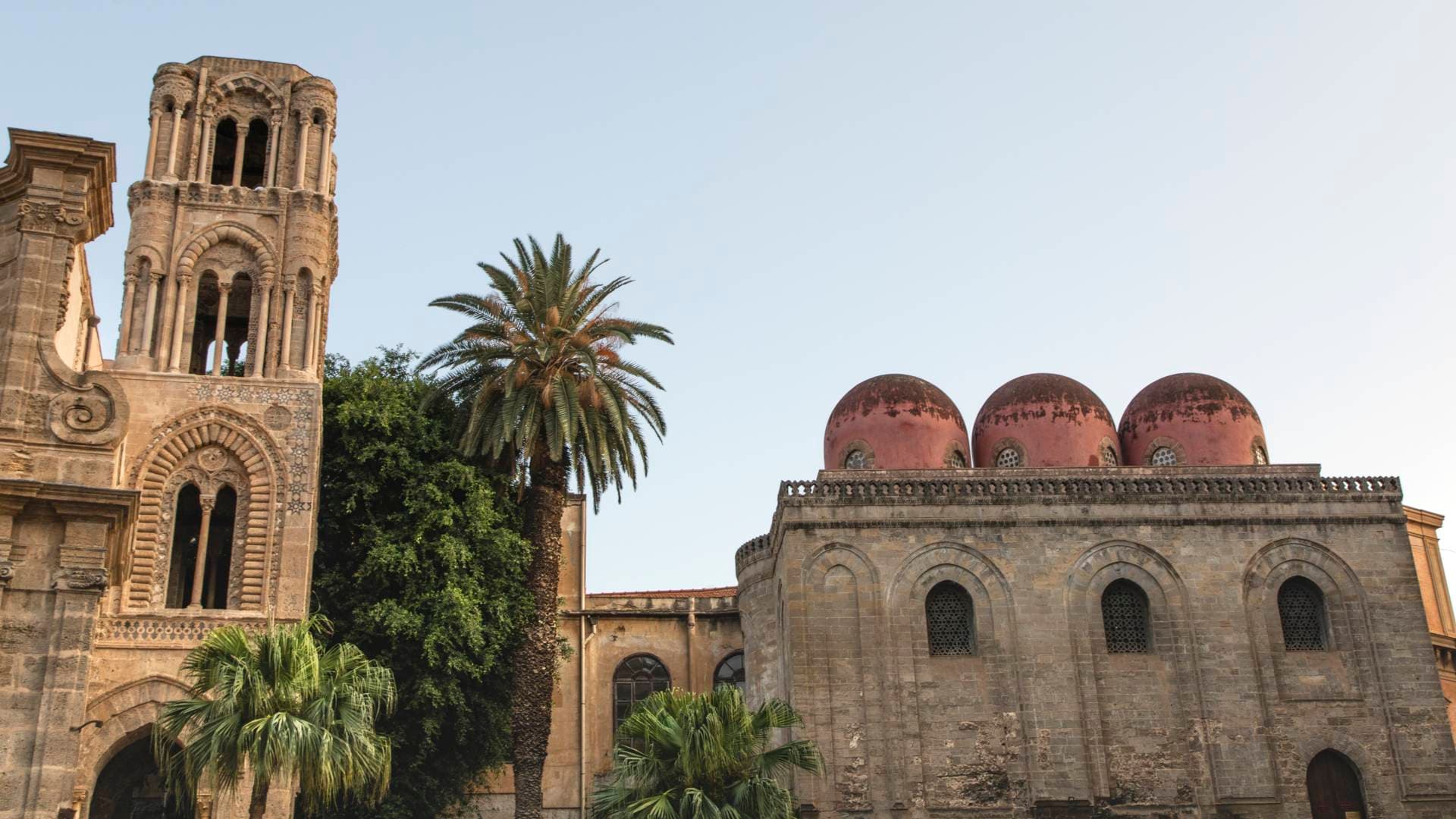
Heading towards the Central Station you reach the Quattro Canti; just beyond lies Piazza Pretoria, also known as the Square of Shame, an admirable example of Sicilian Baroque, overlooked by the Palazzo delle Aquile, the City Hall. From there you enter Piazza Bellini, with the Church of Santa Maria dell'Ammiraglio (the Martorana) and the Church of San Cataldo, both on the UNESCO Itinerary. Returning to the Quattro Canti, you climb the Cassaro, passing the Oratory of San Salvatore up to the Cathedral, a splendid example of Arab-Norman architecture: as a testament to the deep integration of cultures, a verse of the Quran is inscribed on the first column at the entrance.
Beyond the Cathedral you reach Porta Nuova and the Norman Palace, with the magnificence of the Palatine Chapel. In a few minutes you can visit San Giovanni degli Eremiti, another masterpiece of the Itinerary, recognisable by its enchanting red domes. From here you can venture into the historic market of Ballarò, a kaleidoscope of sounds, colours, aromas and faces, and through alleys and stalls reach Casa Professa, a splendid example of Sicilian Baroque. Passing beside the Faculty of Law you return to Piazza Pretoria and, walking back up Via Maqueda, to the B&B once more — for an espresso or a hot tea you can easily make in your room.